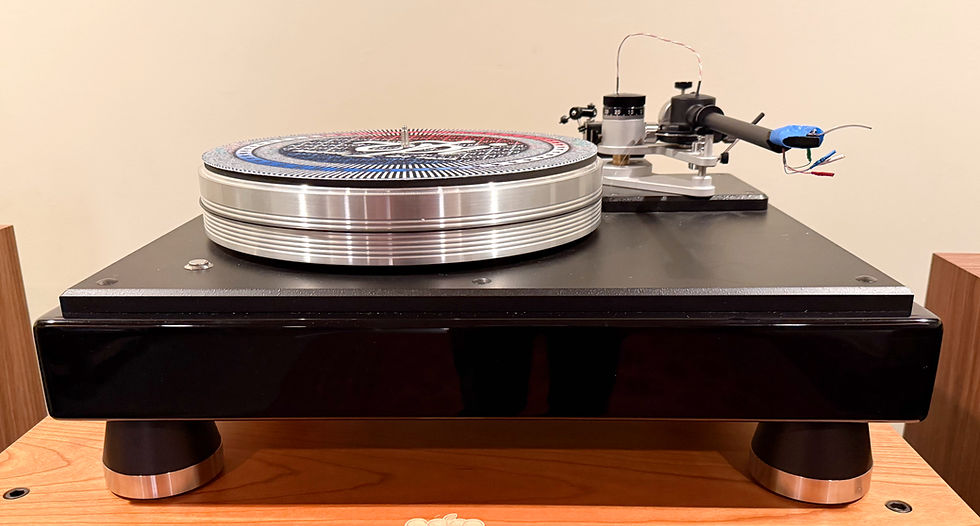
Used Brinkmann Balance 25th Anniversary Turntable + HRS turntable platform + Brinkmann Edison Power Supply + HRS PSU platform for sale.
- This is sold only as a complete package.
- The platter can be relaminated by Brinkmann. It's only a cosmetic issue and does not affect performance. It is the buyer's responsibility to relaminate if wanted. Contact us for pricing.
-----
In the fast-paced, technologically driven world of High-End Audio, it is the rare product indeed that defies obsolescence. It is even more uncommon—and more impressive—when a product can continue to evolve and improve for decades without losing its identity. After 35 years of continuous refinement, the Brinkmann Balance is just such a product. Thanks to the validity of its original design principles on the one hand and the ability of its inventor to relentlessly innovate on the other, the Brinkmann Balance is at once both „Classic“ and „Avant Garde“.
The story of the Balance begins with Helmut Brinkmann’s design philosophy which is, in a word, simplicity. Every aspect of the Balance’s design—and that of all Brinkmann products—has been distilled to its essence, which has enabled the Balance to achieve „Classic“ status. It also means that Brinkmann turntables are uniquely simple and hassle-free to install and optimize; what’s more, their setups will remain stable over time, mitigating the need for periodic tuning or readjustment.
Given the iconic status of the Balance, as well as the numerous innovations and enhancements that have attended its long history, Brinkmann Audio has authored this short history of the of our Flagship Turntable.
Helmut Brinkmann’s first turntable, named "Konstant", debuted in 1980 and embodied the design principles employed in the Balance series of turntables. Designed for "Audiolabor", Helmut’s original company, the ‘table had a heavy platter, a suspension system and versatile tonearm bases that mounted on steel rods. The tonearm based on the Konstant lacked ultimate rigidity but the arm mounting flexibility was a very popular feature; as a result, an evolution of this concept has found a revival in Brinkmann’s Spyder turntable. Theoretical models coupled with manufacturing experience proved that the combination of a heavy platter and suspension wasn’t ideal because once the suspension is set into motion, it tends to remain in motion. The high mass platter was considered essential because it gave volume, weight and energy to the sound, so a "Suspension-less" solution was required. This technique has been employed in all subsequent Brinkmann Turntables.
The heavy platter also made it essential to have a high precision, close tolerance bearing to reduce “Platter Rocking,” defined as any extraneous, i.e., non-rotational, motion of the platter. The need for ultra-precision tolerances inspired Helmut to develop the Heated Bearing because materials like steel and aluminum expand or shrink with changes in temperature. Due to friction-induced heat, traditional (i.e., non-heated) bearings expand as the platter spins; therefore, tolerances must be a compromise between initial and operational bearing temperature. By comparison, heating the bearing allows for optimal tolerances since the bearing temperature doesn’t fluctuate and tolerances therefore remain constant over the life of the turntable. Thanks to the Heated Bearing design pioneered by Brinkmann, the Balance achieves its best sound quality from the moment of turn-on: a “First” in turntable design!
Two other features developed for with the Konstant and retained for the original Balance were the glass platter mat and the clamping system. The first Konstant TTs had an acrylic mat which scratched easily, expanded and contracted with temperature and therefore compromised the intimate connection between platter and record; additionally, compared to crystal glass, acrylic sounded less open. Helmut experimented with a rubber mat suction system to enhance the connection between platter and LP, but the rubber collected dust, was almost impossible to keep clean and consequently damaged the LPs over time. Glass solved the problems inherent to both the acrylic and rubber employed in the Konstant. To this day, rigorous sonic evaluation and selection of every part and material used in every Brinkmann product is a foundation of Brinkmann Design Philosophy.
Brinkmann’s Clamping System, comprised of a spacer and record clamp, provides excellent contact between platter and LP, and ensures the LP doesn’t slow down when the cartridge hits heavily modulated grooves. The tension in the LP that is created by the spacer raising the LP in the middle and the clamp forcing it down transmits sound faster, like a tight guitar string transmits sound faster than a loose string.
The first few Balance Turntables were shipped in 1985. This early production did not utilize threaded spikes; as a result, the underside of the chassis made full contact with the surface upon which it was placed. This was a workable solution for some systems, but not ideal for all. Spikes were added in 1987 because they function as a focused and fast resonance discharge point, providing unidirectional energy drainage sometimes called a “Mechanical Diode.” The recommendation that provides the best results in most systems is to have the spikes barely extended (i.e., as close to the chassis as possible) so that the chassis is barely lifted above its mounting surface. (When the chassis has full contact and the spikes don’t touch the surface, the sound might be less dynamic in some systems…experimentation is recommended!)
The first iteration of the Balance had a simple “Wall Wart” Power Supply Unit (PSU) that connected to the motor housing. In 1987, the addition of the bearing heater required more power and a stand-alone PSU. The development of this outboard power supply demonstrated what Helmut Brinkmann already knew from designing amplifiers: parts like capacitors, for example, could have a dramatic influence on the sound. Consequently, the drive circuitry and PSU underwent a series of changes and updates over time. This fascination with power supply design also led to the creation of the RöNt Tubed Power Supply in 1993. A friend of Helmut’s acquired a large quantity of East German (Russian) army tubes and Helmut decided to investigate how a PSU with tubes might sound. The result of Helmut’s research was the RöNt, now in its third iteration, which further enhances the state-of-the-art performance of the Balance (…and all other Brinkmann turntables!) providing a richer, more liquid and musical sound. In 2010, the Balance celebrated 25 years of series production. Brinkmann celebrated with a numbered, limited-edition 25th anniversary model which included a specially developed Isolation Base designed in conjunction with HRS (Harmonic Resolution Systems). This HRS M3X option is still available and provides the ultimate platform for the Balance.
In 2018, to celebrate the “33-1/3 Anniversary” of the first Balance, Brinkmann launched a numbered and custom-engraved Special Edition Balance (a 2-arm model) which included a 12.1 tonearm, bespoke HRS Isolation Base, RöNt II with NOS Mullard Tubes, Anniversary Book and Custom Flight Case. More recently, Helmut wanted to replicate—and improve upon—the sound of the Mullard GZ34 Rectifier Tube, which he considered the best sonic choice with our RöNt but which has become virtually unavailable. Brinkmann introduced the RöNt III Tubed Power Supply which features Helmut’s proprietary BZ34 “Rectifier Tube Simulator” which, when compared to available tubes, offers superior performance, ideal unit-to-unit consistency and greatly extended lifespan. RöNt III also features revised ground paths and other circuit enhancements.